The problem behind the system.
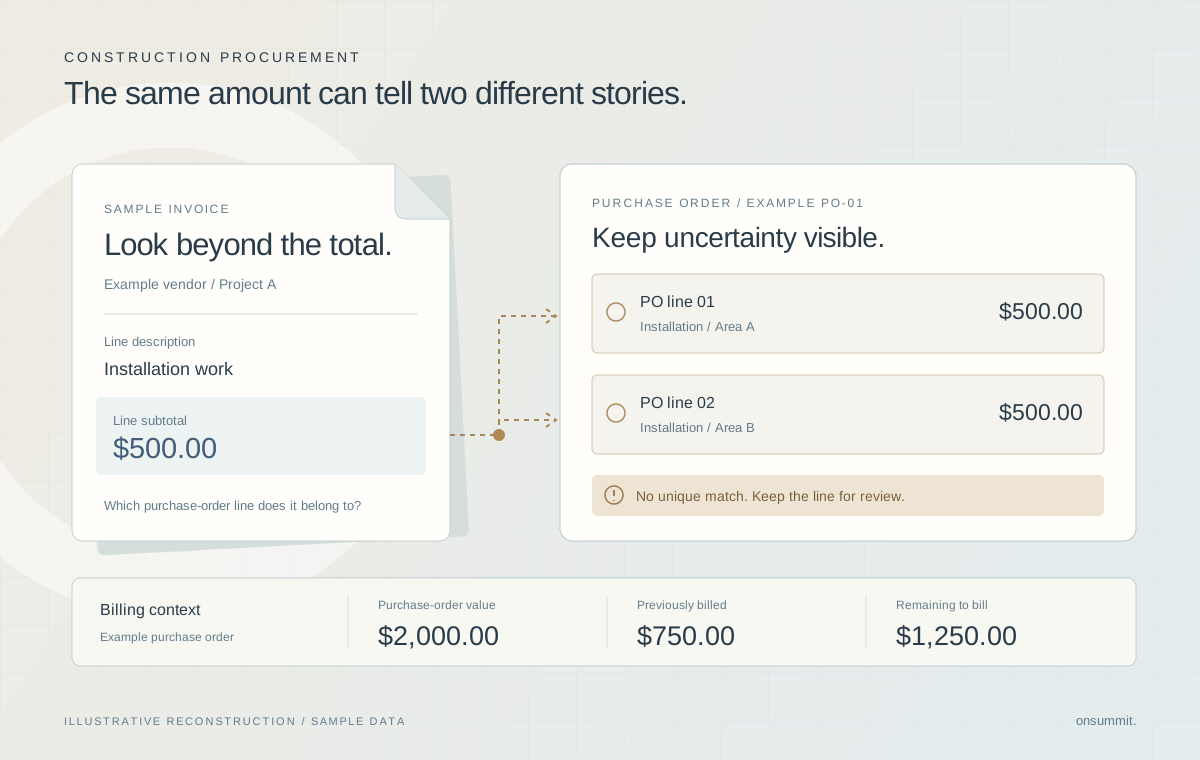
In a project-based construction business, reviewing an invoice involves more than comparing totals. The reviewer needs to understand the vendor, project, purchase order, prior billing and whether the contracted work is complete. Partial invoices and repeated line amounts make a guessed match especially unhelpful. The application brings these relationships into the review process.
- Invoice lines can share the same amount, so a matching rule must be able to return an ambiguous result.
- Operational completion and financial approval represent different responsibilities and validation steps.
- The wider platform contains contributions from the consulting delivery team, client technology teams and managed-package vendors.
Team contribution
The delivery team contributed to procurement customization, including purchase-order and payable review experiences and financial context. Later client technology-team extensions also form part of the system. The matching and completion-related components described here belong to that broader solution, with contributions from both the original delivery team and the client's technology teams.
The decisions that shaped the work.
Allow matching logic to preserve uncertainty.
Two purchase-order lines can have the same pre-tax amount. An invoice-level tolerance cannot determine which line an invoice belongs to.
In the wider solution, the matching service searches within the selected purchase order and distinguishes a unique subtotal match from no-match and ambiguous outcomes. Selected source tests cover these different matching scenarios.
Design consideration. A strict match can leave an invoice line for review. It preserves an unresolved relationship instead of hiding it behind an arbitrary choice.
Put financial context beside the review.
The reviewer needs more than an isolated invoice total to understand the purchase order and its billing history.
The procurement interface brings purchase-order candidates, related invoices and billed or remaining amounts into the same review context. Payable screens and financial measures were extended across successive team contributions.
Design consideration. A displayed accounting measure needs a precise definition. For example, an amount derived from Paid-status invoice lines should not be represented as a cash-payment reconciliation.
Keep completion signals separate from payment decisions.
Completing a project task does not establish that every financial approval condition has been satisfied.
The broader system includes completion propagation and readiness-check components around eligible procurement records. Those extensions have separate implementation and acceptance histories; the core review experience does not depend on a claim that every invoice passes through one automatic gate.
Design consideration. A useful operational signal still needs validated links and an accepted workflow. The case describes the review architecture without asserting completed rollout of the wider gate.
What the system delivers
- One review screen for purchase orders, related invoices and billing details.
- Line matching that distinguishes matched, ambiguous and unmatched results.
- Separate work-completion checks within the wider procurement system.
Technical implementation
- Lightning Web Components and Apex controllers provide review interfaces and data access.
- Dedicated matching and financial-context services extend the accounting environment.
- TaskRay, Accounting Seed and Salesforce Flow support the wider project and procurement platform, with contributions from multiple delivery teams.