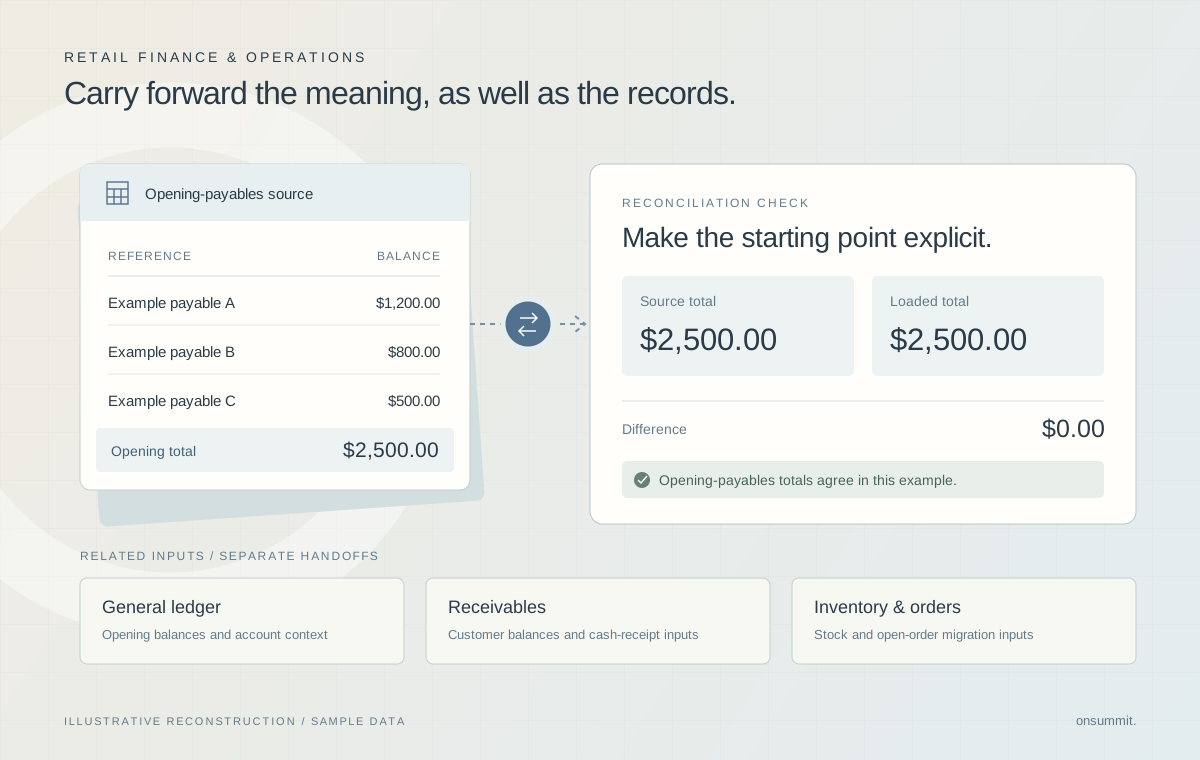
The problem behind the system.
A specialty retailer needed to bring finance and inventory information into a connected ERP environment while retaining the meaning of its opening position. Payables, receivables, ledger balances, open orders and stock data had to be considered together, even though they arrived through different migration tasks and business owners.
- An imported record count does not establish that a financial balance is correct.
- Payables, receivables, general-ledger balances and inventory require distinct preparation and handoffs.
- A completed migration step and acceptance of the entire ERP programme are different milestones.
Team contribution
This example comes from a prior consulting engagement supporting a specialty retailer's ERP implementation. The consulting and client team's documented work includes financial-data coordination, an opening-payables load and reconciliation, and handoffs for the surrounding ledger, receivables and inventory work. Finance stakeholders participated in the migration process. The separate inventory-transfer case describes another workstream within this same retail engagement.
The decisions that shaped the work.
Treat the opening position as connected datasets.
Finance and warehouse records have different purposes, but both affect the position the business carries into a new system.
The migration plan covered ledger balances, receivables, payables, purchase and sales orders, and inventory. Related handoffs kept these parts within the scope of one ERP transition.
Design consideration. A broad migration scope needs coordinated business ownership. It should not be reduced to a claim that one data load completed the whole programme.
Separate loading from reconciliation.
A successful import establishes that records were created; it does not establish that their totals agree with the intended financial position.
The opening-payables work included both loading the records and confirming that the resulting totals matched. The reconciliation is a distinct, documented delivery step.
Design consideration. The confirmed result applies to the payable load. It is not evidence that every ledger, receivable or inventory balance passed the same validation.
Keep handoff and acceptance milestones distinct.
A supplied opening-balance file, a completed load and a business acceptance decision represent different levels of completion.
The migration work was coordinated through separate financial and inventory handoffs. Describing the completed payable reconciliation alongside those handoffs preserves the scope of what was delivered.
Design consideration. This gives a precise account of the migration work without promising a disruption-free cutover or a measured improvement in financial close.
What the system delivers
- Unpaid supplier invoices loaded with totals reconciled to the source.
- Coordinated inputs for ledger balances, customer amounts owed, receipts and inventory.
- A finance and inventory system subsequently used for retail records.
Technical implementation
- Salesforce and Accounting Seed provide the target financial and operational environment.
- Migration work covered financial opening balances and related open-order and inventory inputs.
- The documented payable reconciliation supplies a concrete control within the broader migration effort.